
TransXChange
Examples 2.1 - Express route
Summary
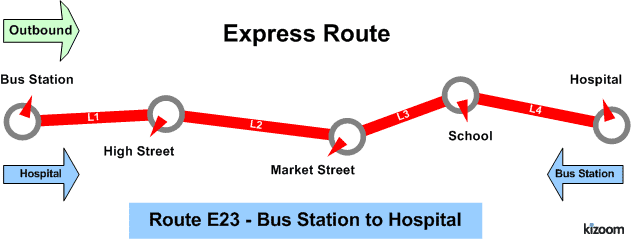
A linear route with express journey patterns running over it that omit stops.
- Express service.
- Short working
- Vehicle journey timing link reuse
- Overriding of Journey Pattern Timing Link Run Times with different values on the Vehicle Journey Timing links for some journeys
- Additional Wait times at stop; on arrival, on departure, on first or intermediate sto
- Monday to Sunday Servic
- Holiday Day Type Exclusions.
- Local Stop Point definitions for an Off Street Bus Station: BCQ, BCE and BCS Stop Types
- Local Stop Area definition for bus station
- Vehicle Journey Footnote
- Variable Bay Allocation
- General Schema
| TransXChange XML Document | Particulars and Matrix output PDF | Route Map Output |
|---|---|---|
| express.xml (One direction only) |
Particulars and Matrix PDF | Route Map PDF Route Map PDF (no background) |
Route Map
Timetable
| #1 | #2 | #3 | #4 | #5 | Stop Types | ||
|---|---|---|---|---|---|---|---|
| E23 | E23 | E23 | E23 | E23 | |||
| Bus Station, Bay Area | dep | 10:00 | 11:00 | 12:00 | - | 14:10 | BCE + BCQ + BCS(x3) |
| Tweeham, High St | arr | 10:03 | 11:03 | - | - | 14:18 | BCT |
| dep | 10:03 | 11:03 | - | - | 14:28 | ||
| Tweeham,Market St | dep | 10:07 | - | 12:07 | 13:07 | 14:37 | BCT |
| Tweeham,School | arr | 10:20 | 11:20 | - | 13:20 | - | |
| dep | 10:20 | 11:20 | - | 13:30 | - | BCT | |
| Tweeham,Hospital | dep | 10:29 | 11:29 | 12:29 | 13:39 | - | BCT |
- Service operates from 01/01/2004 until 13/06/2004
- Service operates Monday to Sunday
- Service does not run Christmas Day, Boxing Day, Good Friday, New Years Day, Late Summer Bank Holiday (Not Scotland), May Day,
Easter Monday, Christmas Day Holiday, New Years Day Holiday,
ChristmasEve, NewYearsEve - Service does not run 02/06/2004
- Service runs 01/06/2004
- Services #1-#4 normally run from Bus Station Bay 1.
- Service #1 runs from Bus Station Bay2 2004-08-01 to 2004-10-
- Service #5 always runs from Bus Station Bay 3,
In this example the last journey overrides the default run times . In additional additional wait times are specified for some stops. The following table shows the timetable additionally annotated with the vehicle journey run times ( default values inherited from the journey pattern shown in brackets) and the wait times (additional wait times prefixed by a +).
| JP Run Time (Mins) |
VJ run & Wait | #1 | VJ run & Wait | #2 | VJ run & Wait | #3 | VJ run & Wait | #4 | VJ run & Wait | #5 | ||
| E23 | E23 | E23 | E23 | E23 | ||||||||
| start | 10:00 | 11:00 | 12:00 | 14:00 | ||||||||
| Bus Station | dep | 10:00 | 11:00 | 12:00 | +w10 | 14:10 | ||||||
| r3 | (r3) | (r3) | (r3) | sr | +r8 | |||||||
| High St | arr | 10:03 | 11:03 | pass | +w10 | 14:08 | ||||||
| dep | 10:03 | 11:03 | pass | sr | 14:28 | |||||||
| r4 | (r4) | (r4) | (r4) | +r9 | ||||||||
| Market St | dep | 10:07 | pass | 12:07 | 13:07 | 14:37 | ||||||
| r13 | (r13) | (r13) | (r13) | sr | ||||||||
| School | arr | 10:20 | 11:20 | pass | 13:20 | - | ||||||
| dep | 10:20 | 11:20 | pass | +w10 | 13:30 | - | ||||||
| r9 | (r9) | (r9) | (r9) | (r9) | sr | |||||||
| Hospital | dep | 10:29 | 11:29 | 12:29 | 13:39 |
The XML Representation
One way encoding this example would be to have a separate route and journey pattern for each column, thus there would be five routes and five journey patterns, each with a single section. Since however the vehicle travels over the same route in the same order, but just passes by certain stops it is possible also to encode it in a less verbose manner by having a single journey pattern with an stop activity of pass at certain stops.
Service Registration
- The service is not registered
- There is a single Operator.
Service Structure
- There is a singleServiceinstance SV1, with one Line - '1'.
- There are nine StopPoint instances
- Five stops make up a locally defined bus station, comprising an Entrance (bus stop type BCE), an off-street general AccessArea (bus stop type BCQ), and three Bay instances (bus stop type BCS)
- There are four on-street stops, all references to existing NaPTAN stops.
- There is a single RouteSection rs_1 with four RouteLink instances rl_1-rl_4 connecting the stops
- There is a single JourneyPatternSection JPS1 made up of four JourneyPatternTimingLink instances, JPTL1-4, with RunTime values of 3, 4, 13, and9 minutes respectively
- There is a single JourneyPatterninstances;
- JP_1, section: JS_1
- There are five VehicleJourneyinstances, all for Ln_1 - 'E23', and using JP1. The instances all use the same set of JourneyPatternTimingLink instances, but define different stop activities (e.g. pass) to specify the different express stopping patterns:
- VJ_1, with a departure time of10:00, stopping at all stops. VJ_1 appears in column #1.
- There is a variable stop allocation the bay in the bus station, pecified on the From part of the first VehicleJourneyTimingLink - see below
- VJ_2, with a departure time of11:00 (column #2), which has a timing links annotated with a VehicleJourneyStopUsage / Activity of 'pass' for the Market Street stop to indicate that the bus does not stop there.
- VJ_3, with a departure time of12:00 (column #3), which has a VehicleJourneyStopUsage / Activity of 'pass' for High Street. and for School
- VJ_4, with a departure time of13:07 (column #4), which has a short working: a dummy StartDeadRun is used to indicate that the service starts at Market Street.
- There is an extra WaitTime of 10 Minutes on departure from the School stop, specified on the From usage of VehicleJourneyTimingLink VJ4_TL4
- VJ_5, with a departure time of14:00 (column #5), which has a short working: a dummy EndDeadRun is used to indicate that the service ends at Market Street.
- A DynamicDestinationDisplay of Market Street. is used to override the default destination of Hospital.
- Both links of this journey takes longer so has a explicit override values of 8.00 and 9.00 minutes for the RunTime on the VehicleJourneyTimingLink instances of the Journey
- There is an extra WaitTime of 10 Minutes on arrival at the High Street stop, specified on the To usage of VehicleJourneyTimingLink VJ5_TL1
- VJ_1, with a departure time of10:00, stopping at all stops. VJ_1 appears in column #1.
The Operating Days
- The Service operating period for SV_1 starts on02/01/2002 for all vehicle journeys and continues indefinitely
- The OperatingProfile for the Service SV_1 states values that apply to all journeys unless overridden on a journey pattern or individual vehicle journey.
- The RegularDayType specifies journeys of the service run Monday to Sunday every week of the year
- The BankHolidayOperation / DaysOfNonOperation states journeys of the service do not run LateSummerBankHolidayNotScotland, MayDay, EasterMonday, ChristmasDayHoliday, NewYearsDayHoliday,
ChristmasEve, NewYearsEve - The SpecialDaysOperation / DaysOfOperation states that journeys of the service are will run on 01/06/2004 regardless.
- The SpecialDaysOperation / DaysOfNonOperation states that all services will not run on 02/06/2004.
Variable Stop Allocation
The use of bays in the bus station for the stop varies for different vehicle journeys within the day, and on different days
- The Route and JourneyPattern specify that the Service goes to a StopPoint of type BCQ in the Bus Station.
- The Bus Station is also defined as a StopArea of type GBCS, and the BCQ StopPoint and the three bay StopPoint instances of type BCS are assigned to it. (This is good practice but is not strictly required in order for the variable allocation to work )
- On the JourneyPatternjp_1, a DefaultStopAllocation assigns the 'Bus Station' BCQ stop to depart from BCS stop 'Bay 1' unless otherwise specified
- The VehicleJourneyinstances override this as follows:
- VJ_1, with a departure time of10:00, A VariableStopAllocation assigns the 'Bus Station' BCQ stop to depart from stop 'Bay 2' between 2004-08-01 to 2004-10-01. Otherwise it will depart from the default, Bay 1.
- VJ_2, VJ_3, VJ_4, use the journey pattern default.
- VJ_5, A DefaultStopAllocation assigns the 'Bus Station' BCQ stop to always depart from stop 'Bay 3' .
Alternate XML Representation
It would also be possible instead of using dead runs to indicate the short working, to simply use a 'pass' activity for the two successive end stops not visited on each of the two journeys that are short workings.
Page last updated: 2013/04/13

